
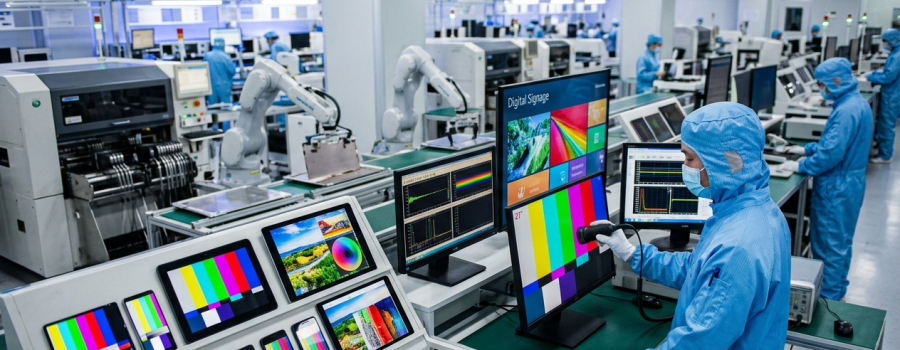
Although LCD modules (Liquid Crystal Display Modules, or LCMs) are a relatively mature technology, they have achieved significant breakthroughs in display performance, structure, and energy efficiency in recent years, thanks to continuous technological upgrades and a mature industry chain. Facing competition from emerging display technologies such as OLEDs, LCDs have maintained strong vitality and a dominant position in the low-to-mid-range consumer market and professional applications through technological evolution.
Latest Development Trends in LCD Modules
1. Backlight Technology Upgrade: Mini-LED Becomes Standard in High-End LCDs
- Fine Dimming and High Contrast Ratio: The weakness of traditional LCDs lies in their low contrast ratio. LCDs using Mini-LED backlight modules (often called QD-Mini LED or local dimming LCDs) can achieve independent light control for thousands or even tens of thousands of ultra-miniature LED zones.
- Image Quality Comparable to OLED: This technology significantly improves HDR performance and black purity, while retaining the advantages of LCDs such as high brightness, long lifespan, and low burn-in risk, making it a favorite for high-end TVs, gaming monitors, and professional design displays.
2. Performance Enhancement: High Refresh Rate and High Brightness
- Ultra-High Refresh Rate: Thanks to the widespread adoption of oxide panel technology and fast liquid crystal materials, LCD module refresh rates have generally reached 144Hz, 240Hz, and even exceeded 360Hz, widely used in gaming laptops and high-end monitors.
- Outdoor High-Brightness Display: The brightness of smartphone and automotive LCD modules has increased significantly in recent years. By improving the transmittance of polarizers and optimizing backlight design, module brightness has generally jumped from 400-500 nits in the early days to 800 nits or even higher, greatly improving visibility in outdoor sunlight.
3. Module Thinning and Enhanced Integration (Narrow Bezels and In-Cell/On-Cell)
- Narrow Bezel Design: Through the adoption of advanced GOA (Gate on Array) technology and more precise packaging processes, the bezels of LCD modules are constantly shrinking, significantly enhancing the visual immersion.
- Integrated Touch: In-Cell or On-Cell touch technology has become mainstream. Integrating the touch sensing layer directly inside the LCD or on the color filter further reduces module thickness and improves light transmittance.
4. Intelligentization and Low Power Consumption
- Intelligent Interaction: An increasing number of industrial control and IoT LCD modules are incorporating “intelligent display” features, integrating SoCs or touch drivers to directly handle simple human-machine interfaces (HMIs).
- Low Power Consumption Technology: Employing energy-saving technologies such as Memory in Pixel (MIP), power consumption during static displays is significantly reduced. This is widely used in low-power scenarios such as smart home control panels and electronic shelf labels.
LCD Module Main Application Areas
1. Automotive Displays (Fastest Growing Sector in Vehicles)
- Multi-screen Trend: Modern cars extensively use LCD modules for dashboards, central infotainment screens, passenger infotainment screens, HUDs (Head-Up Displays), and streaming rearview mirrors.
- Automotive-grade Requirements: Automotive LCDs need high brightness, wide operating temperature range (cold and heat resistant), shock resistance, and high stability. Mini-LED backlit LCDs are rapidly penetrating this field.
2. Esports and High-end IT Equipment
- Gaming Monitors and Laptops: This is currently a crucial arena for LCDs to reach their full potential. The combination of ultra-high resolution (4K/8K), ultra-high refresh rates ($144Hz – $360Hz+), and Mini-LED technology makes them the preferred choice for hardcore gamers and creators.
3. Smart Home and IoT (Internet of Things)
- Smart Terminals: Smart refrigerators, smart access control systems, home control panels, thermostats, and other products are widely equipped with small or micro LCD modules. • Advantages: Since smart home panels require 24/7 (or timed) status display and are cost-sensitive, LCD modules offer extremely high cost-effectiveness.
4. Industrial Control and Medical Equipment
- Industrial Human-Machine Interfaces (HMIs): Industrial control computers and automated equipment dashboards require highly reliable, long-life displays; industrial-grade wide-temperature LCD modules are the industry standard.
- Medical Instruments: Equipment such as ultrasound instruments, ECG monitors, and endoscopic displays have extremely high requirements for color accuracy, viewing angle, and grayscale display; high-end TFT-LCD modules dominate in this area.
5. Traditional Consumer Electronics (Large-Size Scenarios)
- Smart TVs and Commercial Displays: In large-size (75 inches and above) TVs and public display fields (such as digital signage and outdoor billboards), large-size LCD modules still hold the majority of the market share due to their extremely high cost-effectiveness and mature production capacity.