
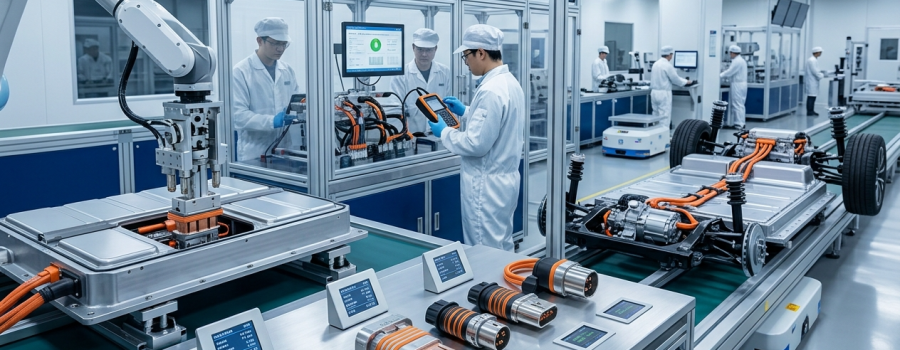
Benefiting from the deepening of electrification and the popularization of intelligent technology, the global new energy vehicle connector market is expected to exceed US$20 billion in 2026, with the Chinese market reaching RMB 71.3 billion. The value of connectors per vehicle has significantly increased, driven by three core demands: high voltage, high speed, and customization. The domestic substitution rate has exceeded 70%.
1. Core Demands and Technological Trends
- High Voltage Connectors (High Current and Safety): With the widespread adoption of 800V high-voltage fast charging architectures, higher requirements are placed on connectors’ voltage resistance, high temperature resistance, and short-circuit protection. The demand for high-voltage connectors is growing at over 15%, especially for sub-categories such as liquid-cooled quick-connect connectors, which are experiencing explosive growth (annual growth rates exceeding 40%).
- High-Speed Data Connectors (Intelligent Technology Demand): Advanced driver assistance systems (ADAS), LiDAR, and smart cockpits are driving exponential growth in in-vehicle data transmission. Ethernet connectors, RF connectors, and high-frequency high-speed connectors have become hot purchases for automakers.
- Lightweighting and High Integration: To alleviate range anxiety, connectors are evolving towards lightweight designs (aluminum-to-copper technology) and multi-functional integrated wiring harnesses, with customized demand now exceeding 65%.
2. Market Competition Landscape
- Accelerated Domestic Substitution: Leveraging cost advantages and rapid supply chain response capabilities, Chinese companies are continuously expanding their market share, with the domestic production rate jumping from 30% in 2020 to over 70%.
- Significant Leading Player Effect: International giants such as TE Connectivity and Amphenol still dominate in high-end and high-barrier sectors, but domestic companies are accelerating their penetration into mid-to-high-end high-voltage/high-speed products.
3. Latest Macroeconomic Environment Impact in 2026
- “Going Global” Becomes the Main Theme: China’s new energy vehicle exports continue to double, forcing domestic connector manufacturers to follow OEMs overseas, establishing production capacity in Europe and Southeast Asia to meet overseas market demand.
- Domestic policy adjustments: Starting in 2026, China will halve the vehicle purchase tax on new energy vehicles, shifting the policy focus from “comprehensive tax exemption for cultivation” to “promoting high-quality technological development,” which will accelerate the technological upgrades of automakers in intelligent hardware and electric drive systems.